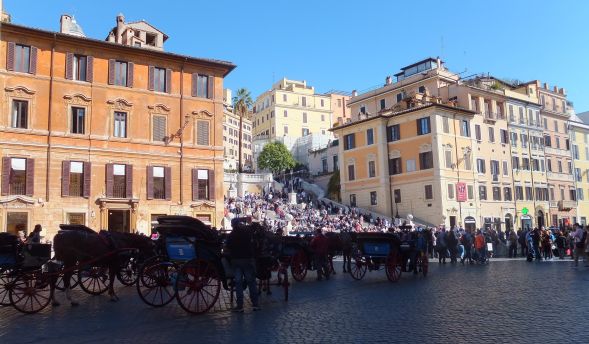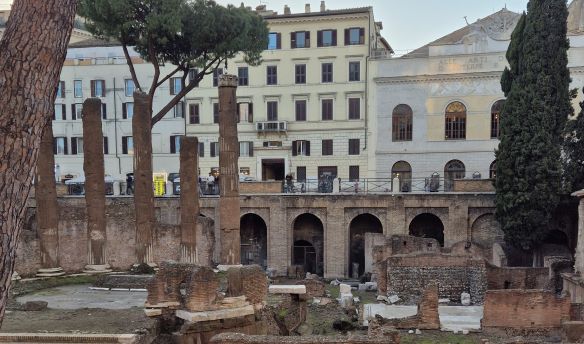


Piazza Navona grabs your attention; it is immense and thronging with people.
In the centre you’ll see street performers: a man suspended in mid air, another blowing giant bubbles that float to the sky.
On the periphery, restaurant staff vie with each other, inviting you to dine.
Look at the Piazza itself. It is famous for the three fountains but, well before the fountains arrived, this area had another purpose. If you are an athlete, the Piazza’s oval shape is probably a clue: it was once home to an athletics stadium.
Emperor Domitian’s athletics stadium
Emperor Domitian
Rome’s Emperors excelled at notoriety but Domitian had a rare distinction. After his death, the Senators tried to erase his memory from history. Statues of him were destroyed and his name removed from official records, but Domitian’s legacy survived.
He was the son of Emperor Vespasian and younger brother of Emperor Titus, whom he succeeded in AD81. Senators looked down on the family, regarding it as insufficiently aristocratic. Nonetheless, Domitian reigned for fifteen years, until he was assassinated by a group of conspirators. The group included Nerva, who became the next Emperor.
After his assassination, writers described Domitian as cruel and authoritarian, but his assassins would have been keen to blacken his name.
With hindsight, Domitian certainly took some actions to benefit Rome. He supported Roman traders and farmers and continued the urban regeneration programme that his father and brother had commenced. The athletics stadium was part of the programme.
The Stadium
The stadium was commissioned, for the benefit of the Roman people, in AD80 and dedicated in AD86 as a permanent venue for athletics. It covers the underground area of Piazza Navona and, when in use, probably had seating for around 30,000 spectators. Like most modern stadia, the seats were gradually raised towards the rear, so that everyone had a good view.
The stadium’s first use was for the Capitoline Games. It was intended exclusively for athletics but, after the Colosseum was damaged by fire in AD217, it was briefly home to gladiator shows.
As Rome declined, the stadium gradually fell out of use and, for a while, its arcades may have become living quarters for the poor.
The archaeological remains are extensive and the features of the old athletics stadium clear to see. The underground area is open daily (https://stadiodomiziano.com) and is worth visiting. The entrance is in via di Tor Sanguigna, at the northern border of Piazza Navona.
The Beginnings of the Piazza
By the end of the 1400s, the ruins of the old stadium mingled with vineyards and huts. Around 1477, redevelopment began and new houses were built. The current Piazza took shape although initially without the embellishment seen today: that would wait until the 1600s.
The Baroque Era
In 1644, a member of the wealthy Pamphili family became elected Pope Innocent X. He commissioned Girolamo and Carlo Rainaldi to enlarge the family residence, which is now Villa Pamphili and rebuild the attached church, now Sant’Agnese in Agone.

He commissioned Borromini to complete the dome and façade.

Meanwhile, Bernini was commissioned to create the Fontana dei Quattro Fiumi (the fountain of four rivers). The Danube represents Europe, the Nile Africa, the Ganges Asia and the Plata America. In the centre is an obelisk, dating from Domitian’s reign that was retrieved by Innocent X from the via Appia.

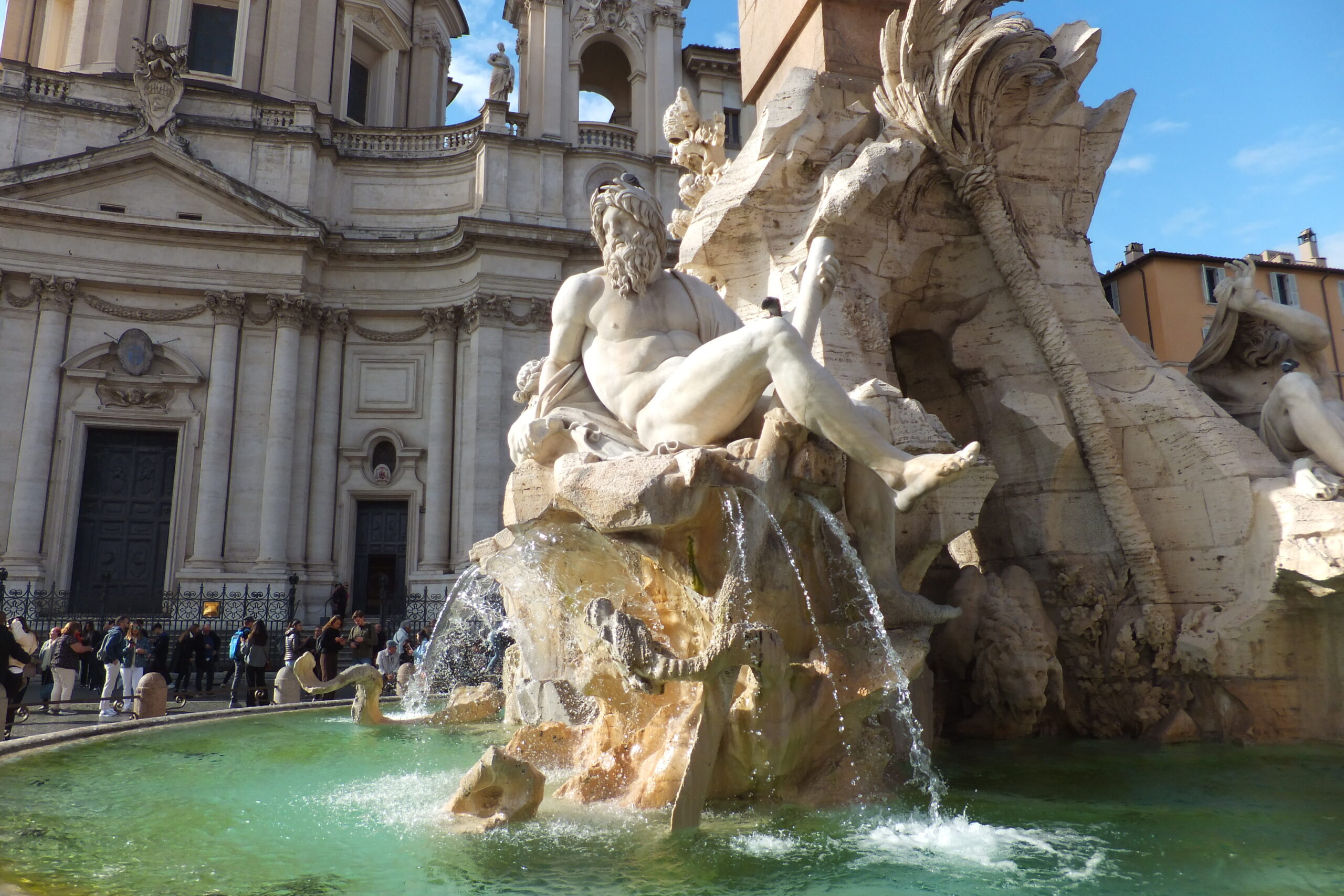
Bernini and Borromini were bitter rivals and Borromini circulated a rumour that the obelisk on the fountain was about to fall over. When the Papal Commissioners confronted Bernini, he laughed and tied a piece of twine between the top of the obelisk and a nearby lamp post.
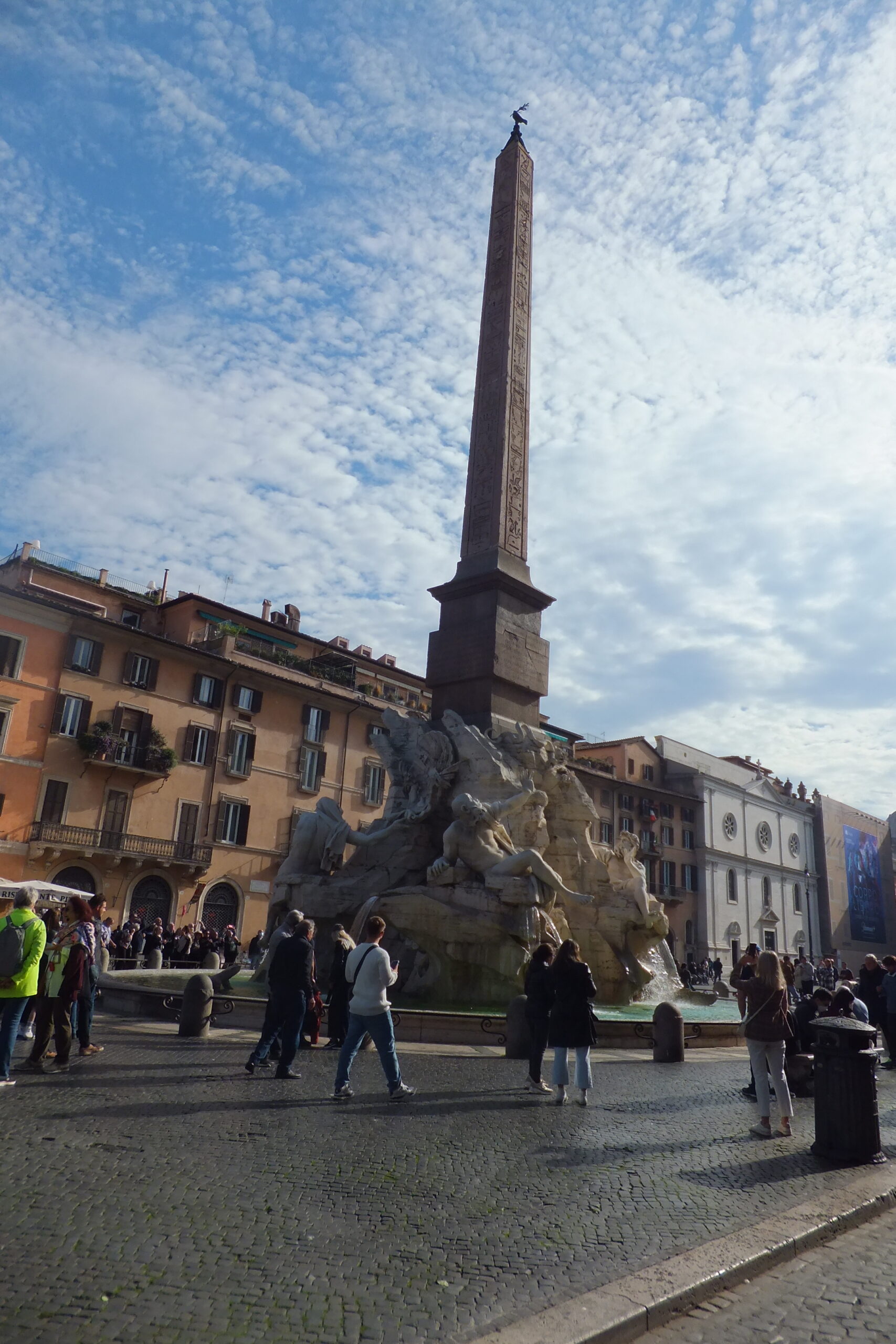
The obelisk (minus twine) remains firmly in place.

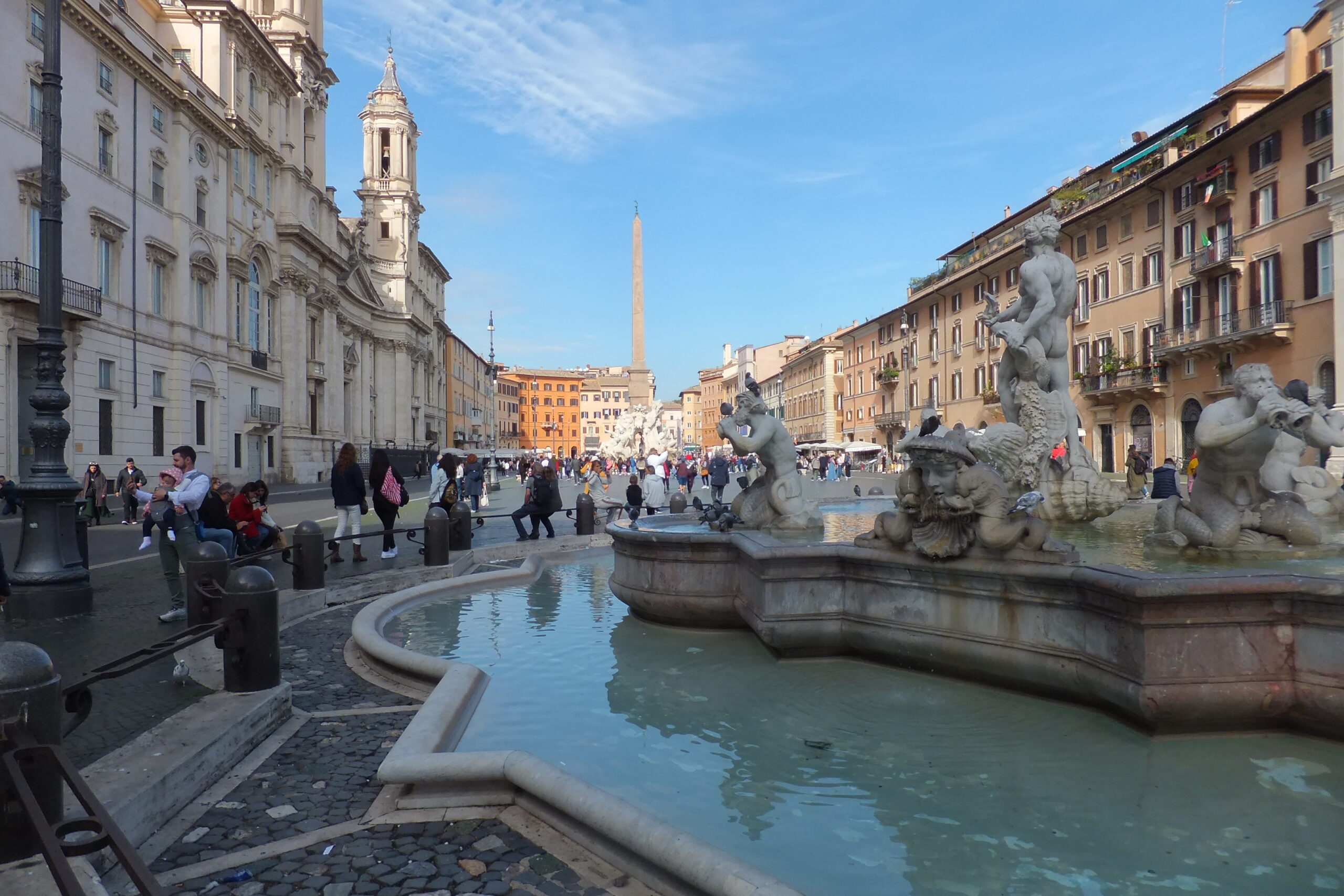
Bernini also designed the central figure of the Fontana del Moro (the fountain of the moor).
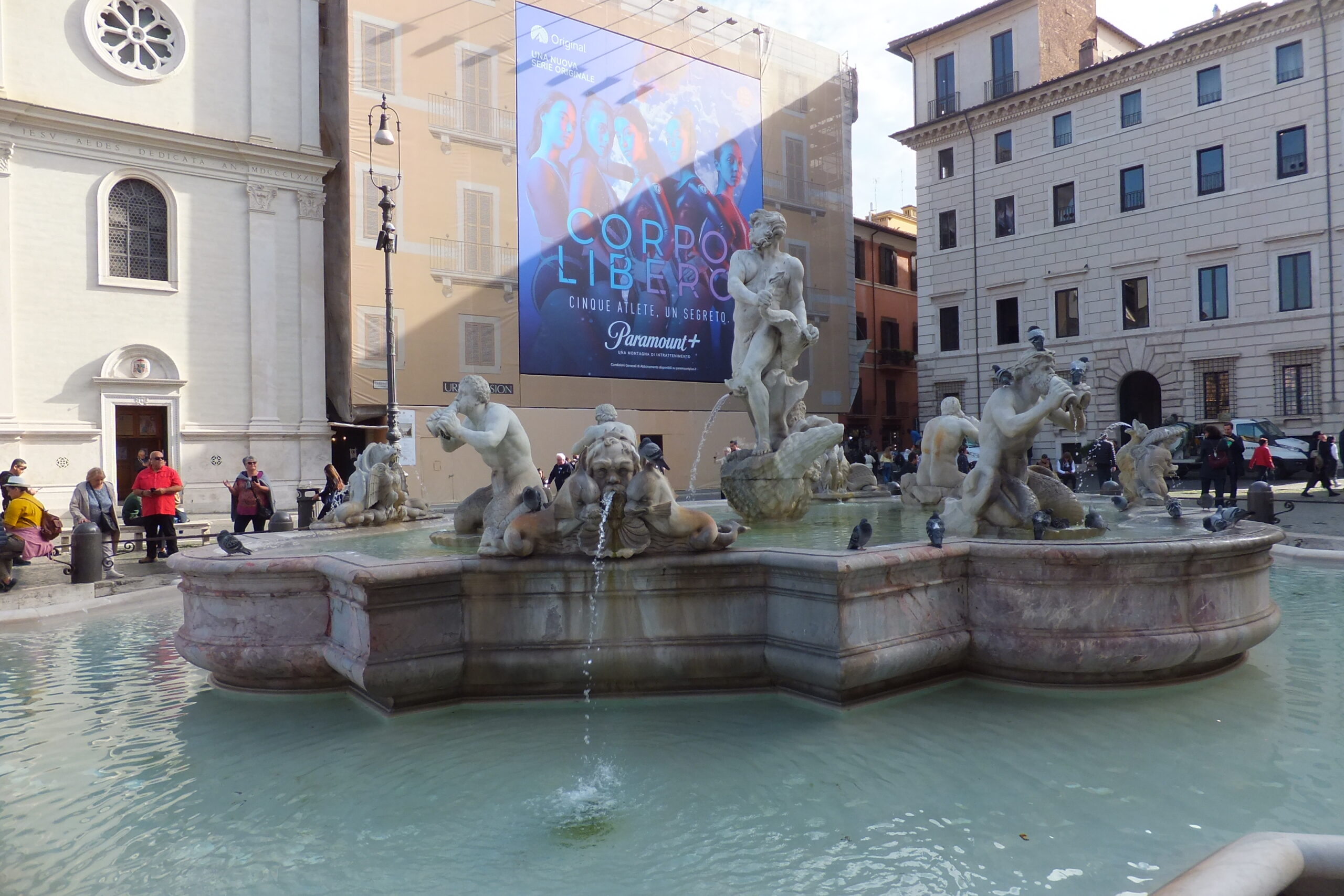
It stands at the southern end of Piazza Navona.

The church of Sant’Agnese is on the left and the obelisk (on the four rivers fountain) is ahead and to the right.
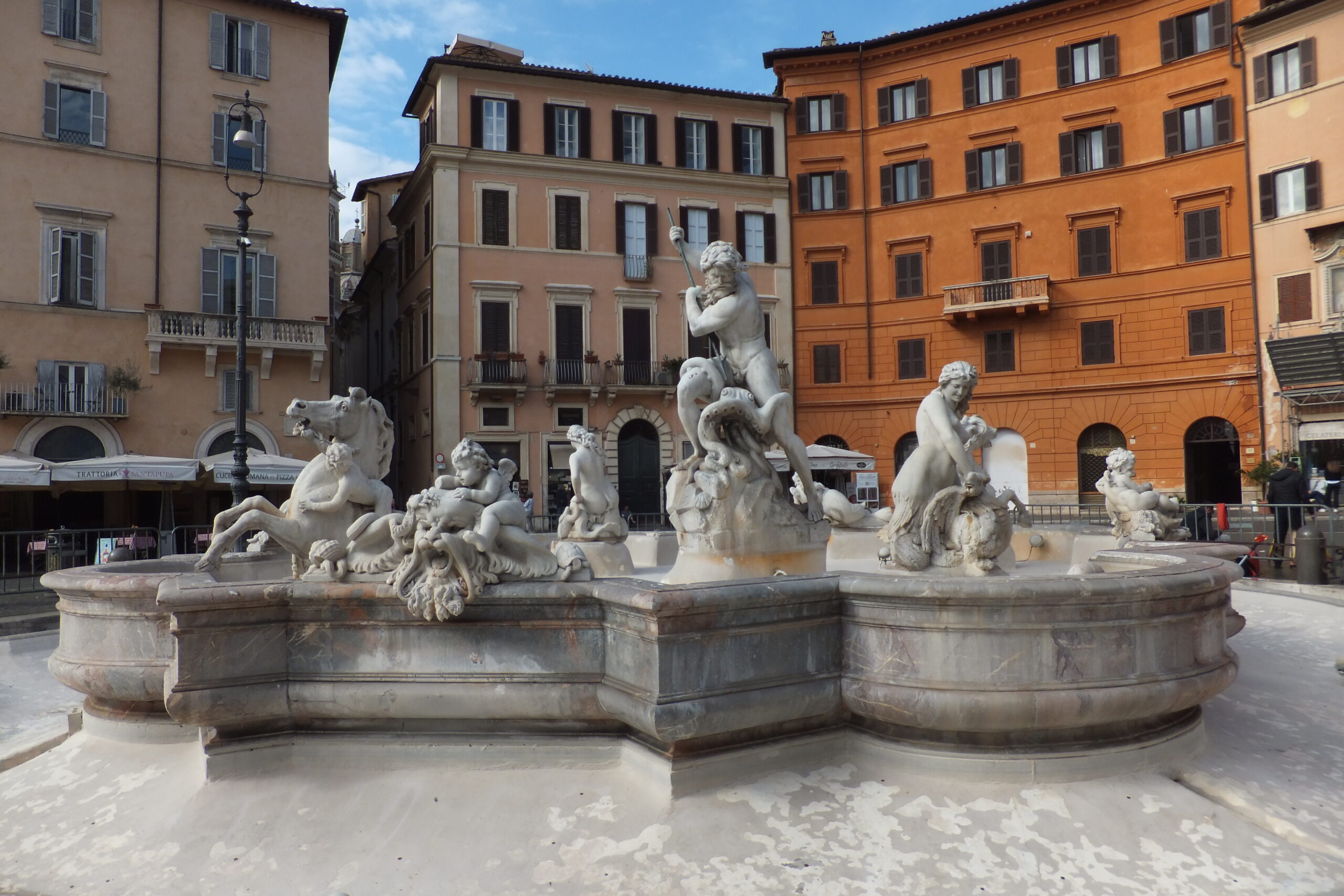
The third fountain, the Fontana di Nettuno (the fountain of Neptune) was only completed in the nineteenth century, when statues, created by Giacomo Della Porta, were added.

Della Porta was Architetto del Popolo Romano (Architect of the Roman People) from 1564 to 1601 and worked on many important projects. He was the designer of the Palazzo Mattei fountain, although Bernini’s turtles were added to the rim some seventy years later.
The Second World War
During the second world war, Piazza Navona remained an important hub of activity … on both sides.
Palazzo Braschi
Palazzo Braschi is today part of the Museo di Roma. It borders Piazza Navona and via San Pantaleo and its rear is just to the south of the Fontana del Moro.
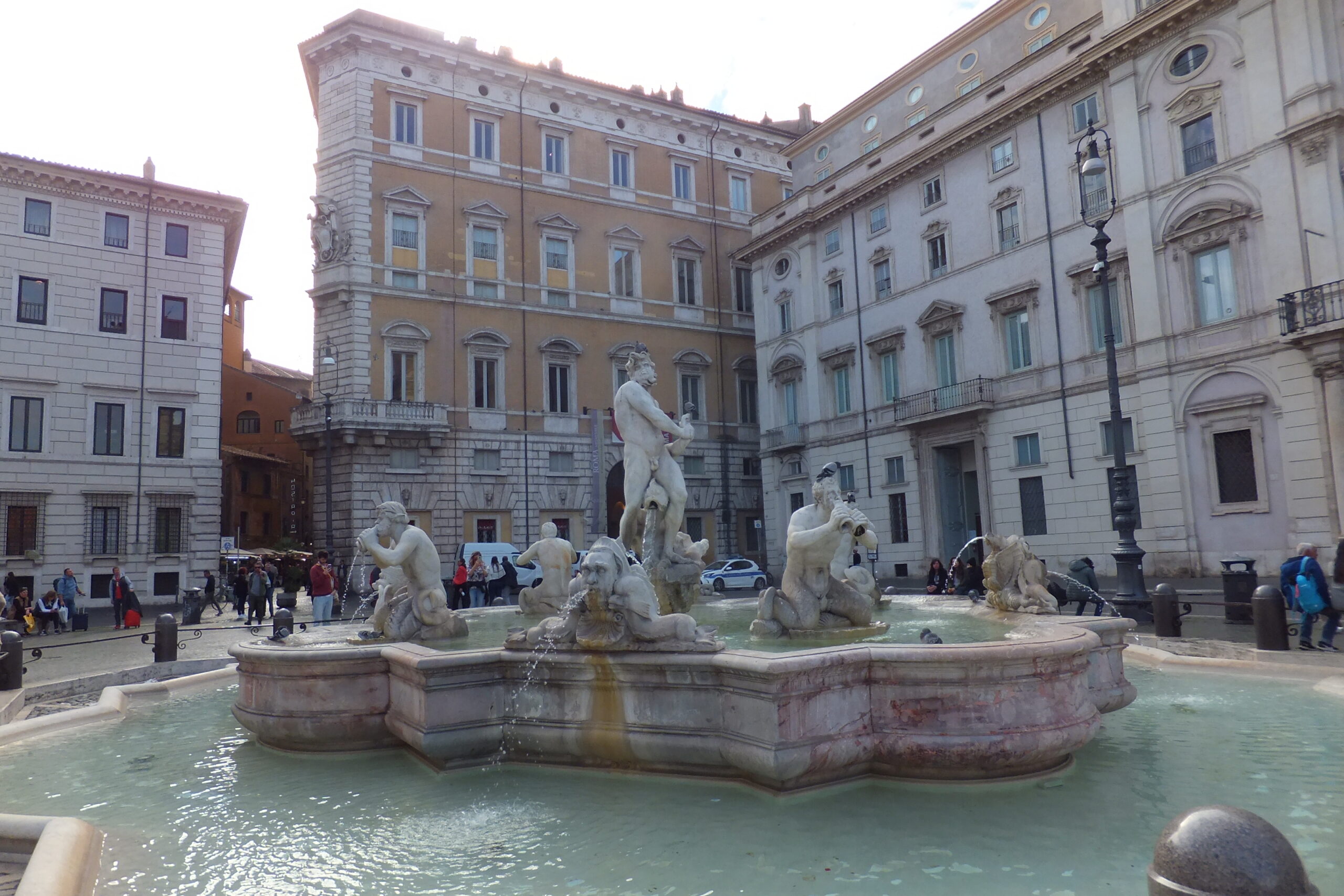
In the 1930s it had become one of the major centres of fascism in Rome and, after the fall of Mussolini in July 1943, it was one of the few places in Rome to be attacked by crowds. The police intervened and the building was closed.
Less than two months later, fascists occupied the building once more and revived the Federazione Romana del Fascismo. By now, the Germans controlled Rome, and they tolerated – and worked with – the Italian fascists, who set about arresting antifascists and members of the resistance.
Sasà Bentivegna
Sasà Bentivegna was a member of Gap (gruppi di azione patriottica – a prominent resistance group) in Rome and his resistance name was Paolo. He saw his first armed action in Piazza Navona, against members of the fascist band from Palazzo Braschi. He and three other gappists followed the men into Piazza Navona: both groups were armed and one man was killed there, a guard from Palazzo Braschi.
Posters in the Piazza
The occupying Germans issued numerous orders, and the quickest way of disseminating them was to post them in prominent places. Piazza Navona was a prime location.
Bentivegna, from the start of the occupation, distributed arms to secret locations in Rome. One was a milk bar in Piazza Navona, now the Tre Scalini (overlooking the four rivers fountain, on the western side).
As he left the building, Bentivegna saw a notice posted on the wall that was signed by the German high command.
It included a list of prohibitions that carried the death penalty:
Participating in black market activity
Listening to allied radio
Hiding a fugitive
Distributing allied leaflets
Possessing arms
Being outside during the curfew
A small crowd had gathered and Bentivegna recalled that the silence was chilling. The Romans around him, sombre and tense, read the list of threats. A soldier put up another poster and they exchanged glances, irritated that this was happening in their beautiful piazza. A third and fourth poster followed and a flicker of irony crossed their faces. The tension was dissipating, and a few began to smile. After the fifth and sixth poster, irony had taken over …