
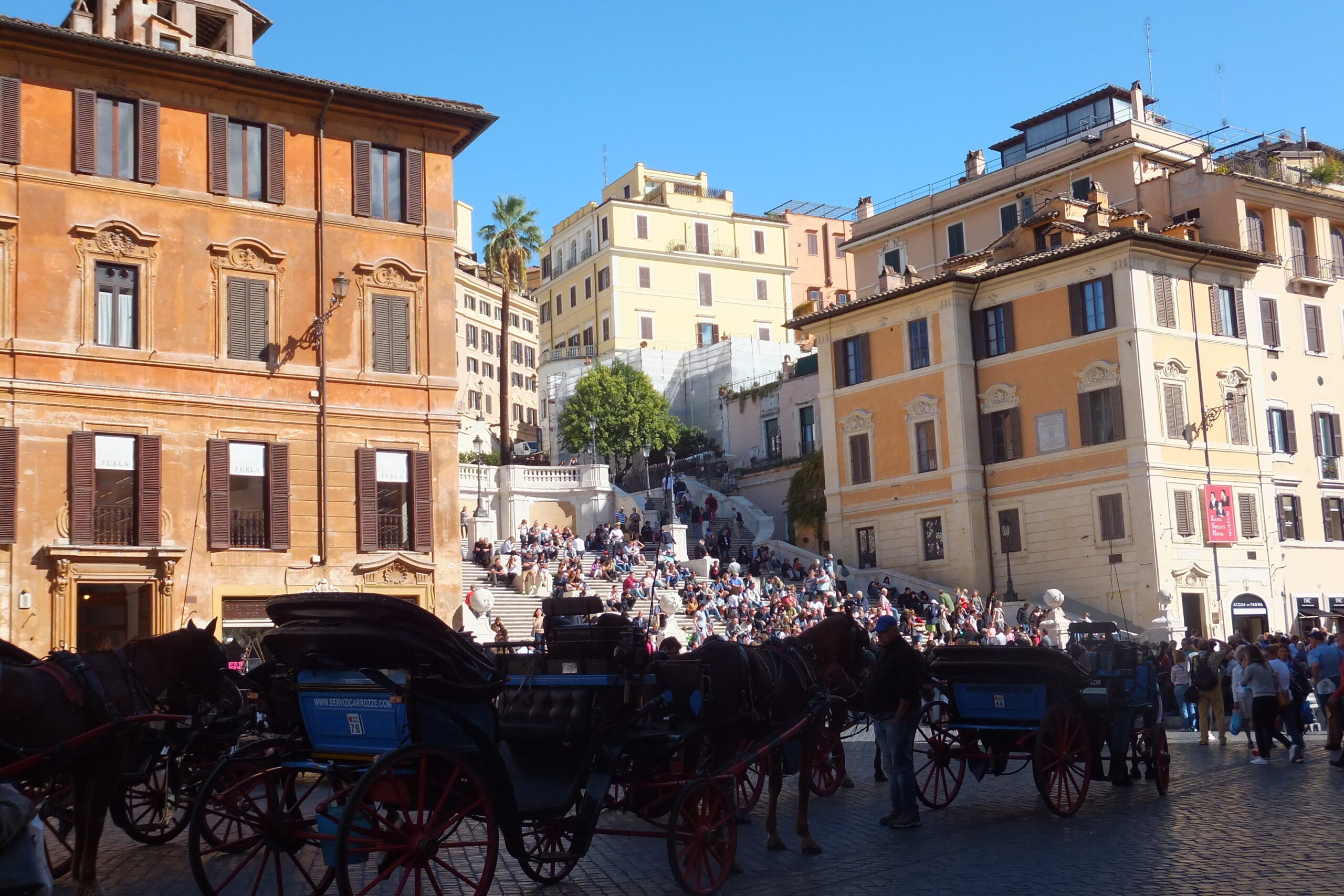
Piazza di Spagna: a piazza in Rome with a Spanish title. Its name dates from the 17th century when the Spanish ambassador to the Holy See took up residence in the Palazzo di Spagna. The surrounding land became Spanish territory but the French, who owned land above around the convent of Trinità dei Monti, claimed the right to pass through. Other nationals who entered this Spanish territory without permission risked being press-ganged into the Spanish army!
The Spanish Steps
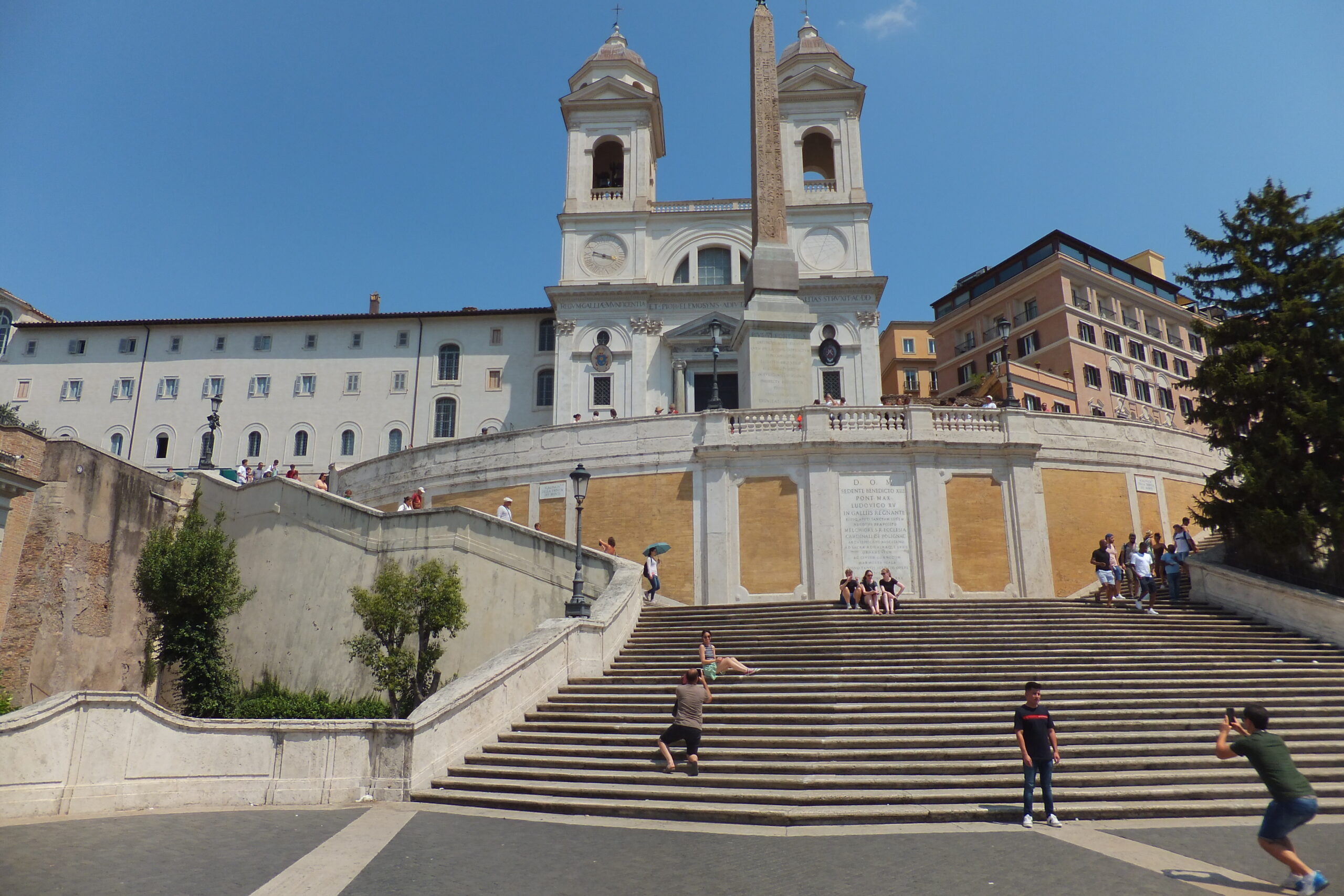
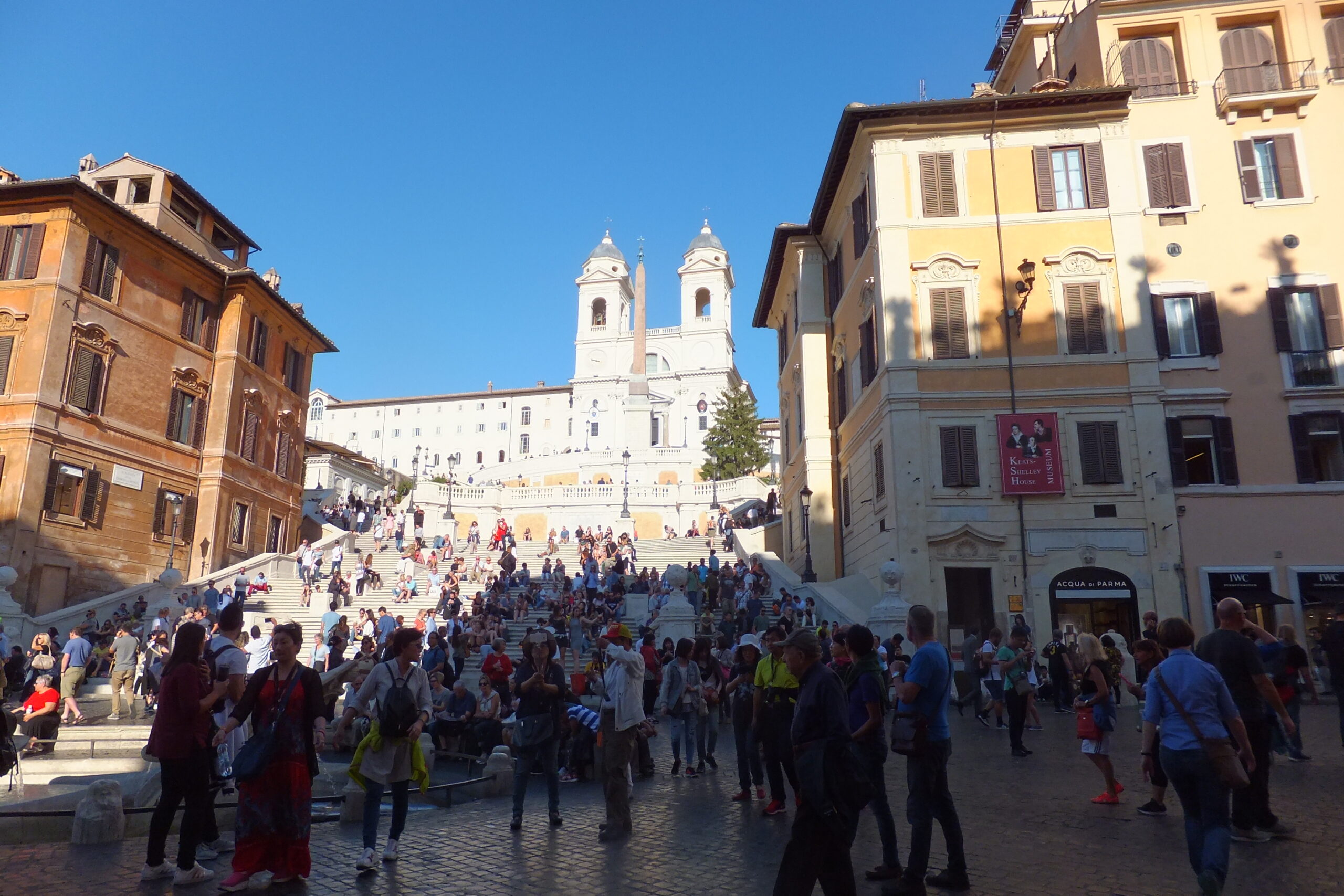
The Spanish Steps (or, more correctly, Scalinata della Trinità dei Monti) were built between 1723 and 1726. More than sixty years earlier, the French and the Vatican had discussed the idea of linking Piazza di Spagna with the church of Trinità dei Monti. Cardinal Mazarin was adviser to the French king, Louis XIV. He supported an extravagant French design but Pope Alexander VII opposed it. The stumbling block was the proposed equestrian statue of Louis XIV that would have dominated the structure.
The disagreements continued, even after the deaths of Mazarin, Alexander VII and the next six popes. Pope Innocent XIII (the seventh pope) finally agreed to a French design, on condition that the statue of Louis XIV was abandoned. By then, Louis XIV had also died and the construction of the present Scalinata went ahead, with an obelisk at the top.
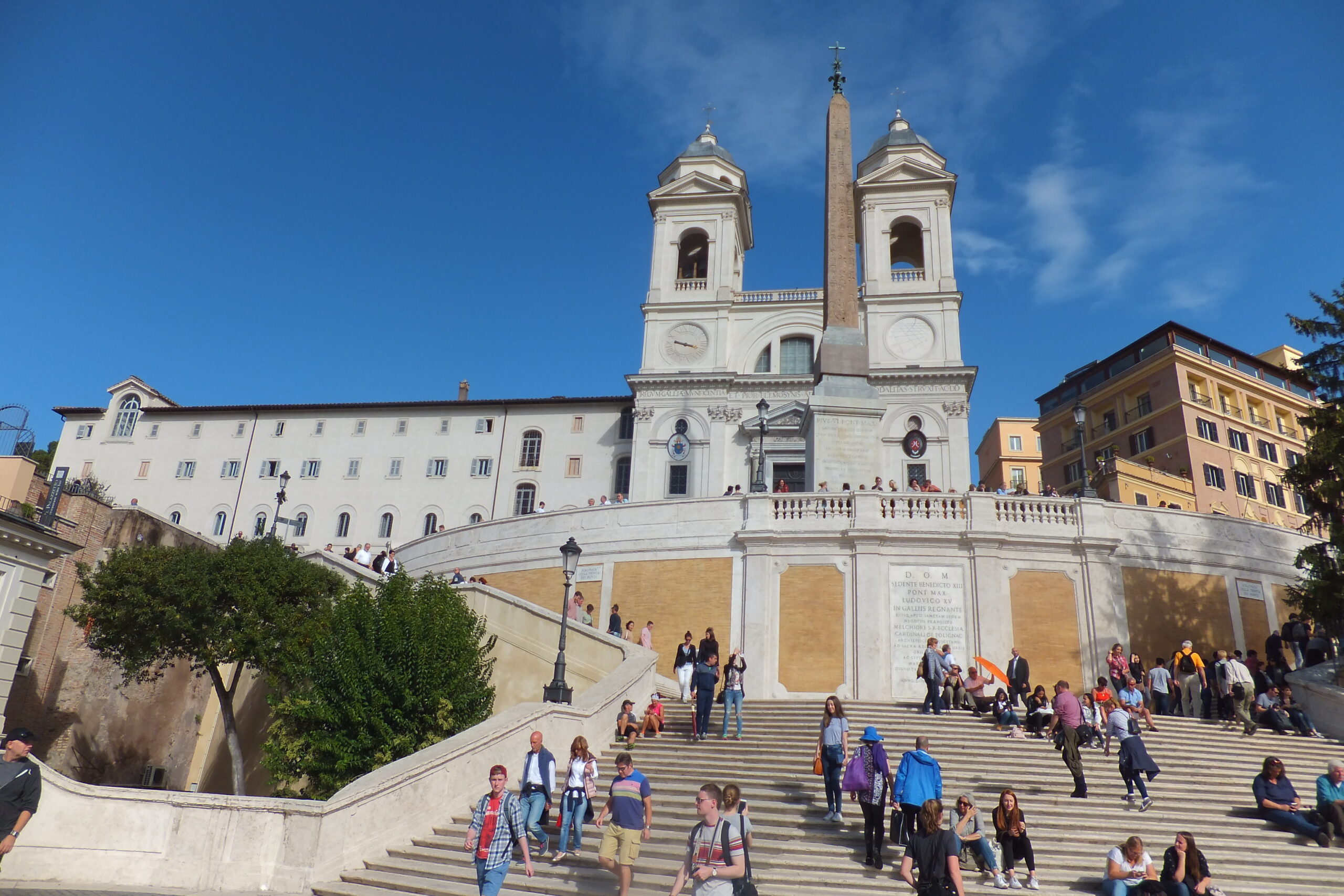

Today, an obelisk – and not an equestrian statue – overlooks Piazza di Spagna!
The obelisk stands in front of the church of Trinità dei Monti.
Students, artists and writers
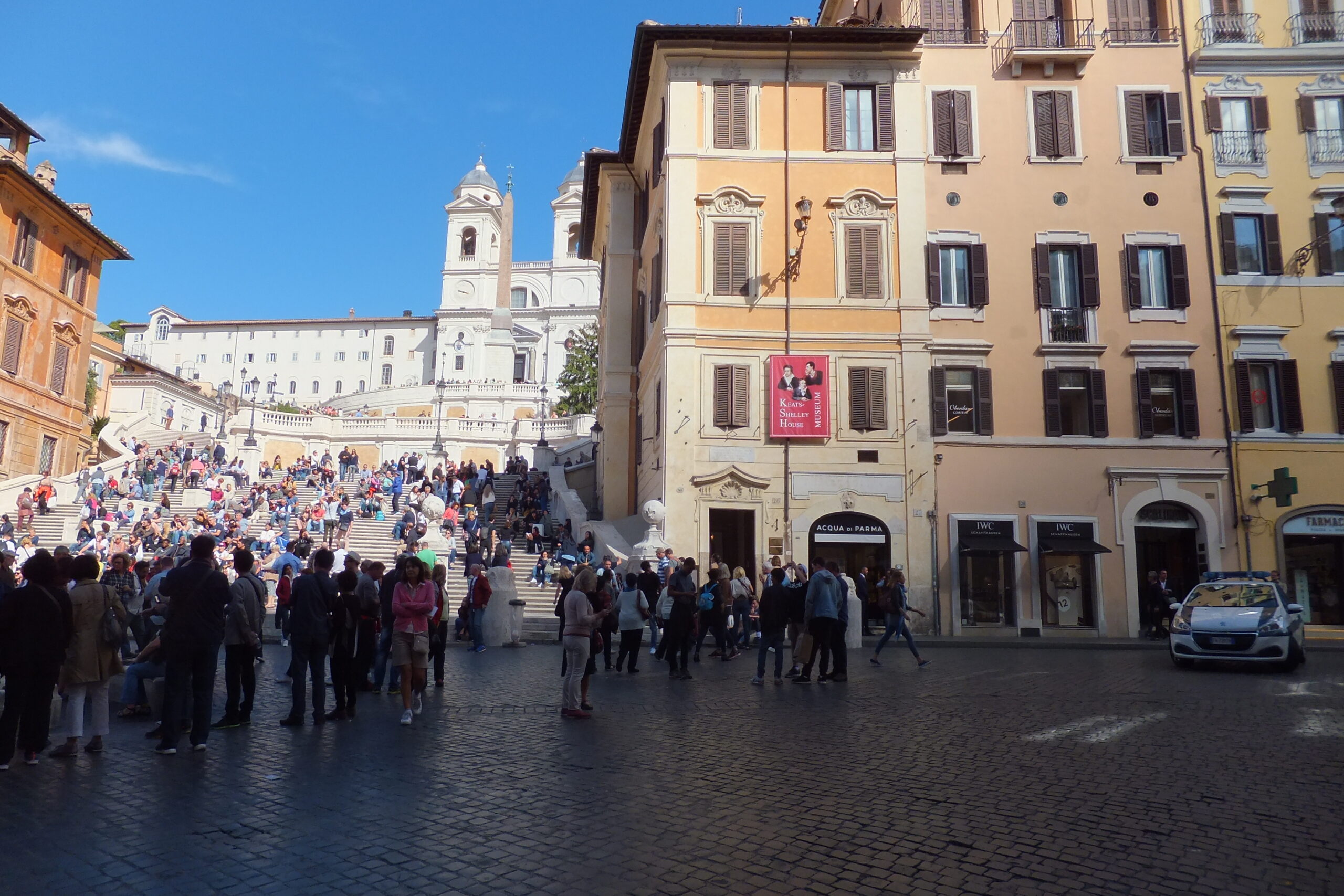
During the 18th century, the area became popular with the sons of wealthy English families, who arrived as part of the Grand Tour. The area also became a magnet for artists and writers of many nationalities.

In November 1820, the English poet John Keats with his friend, the artist Joseph Severn, rented a two room apartment in no 26 Piazza di Spagna, alongside the Spanish Steps. Keats was suffering from tuberculosis and died three months later, nursed throughout by Severn.
In 1906, parties from the USA, England and Italy purchased the house where Keats briefly lived and died. It is now the Keats Shelley Memorial House and Museum.
A meeting place and thoroughfare
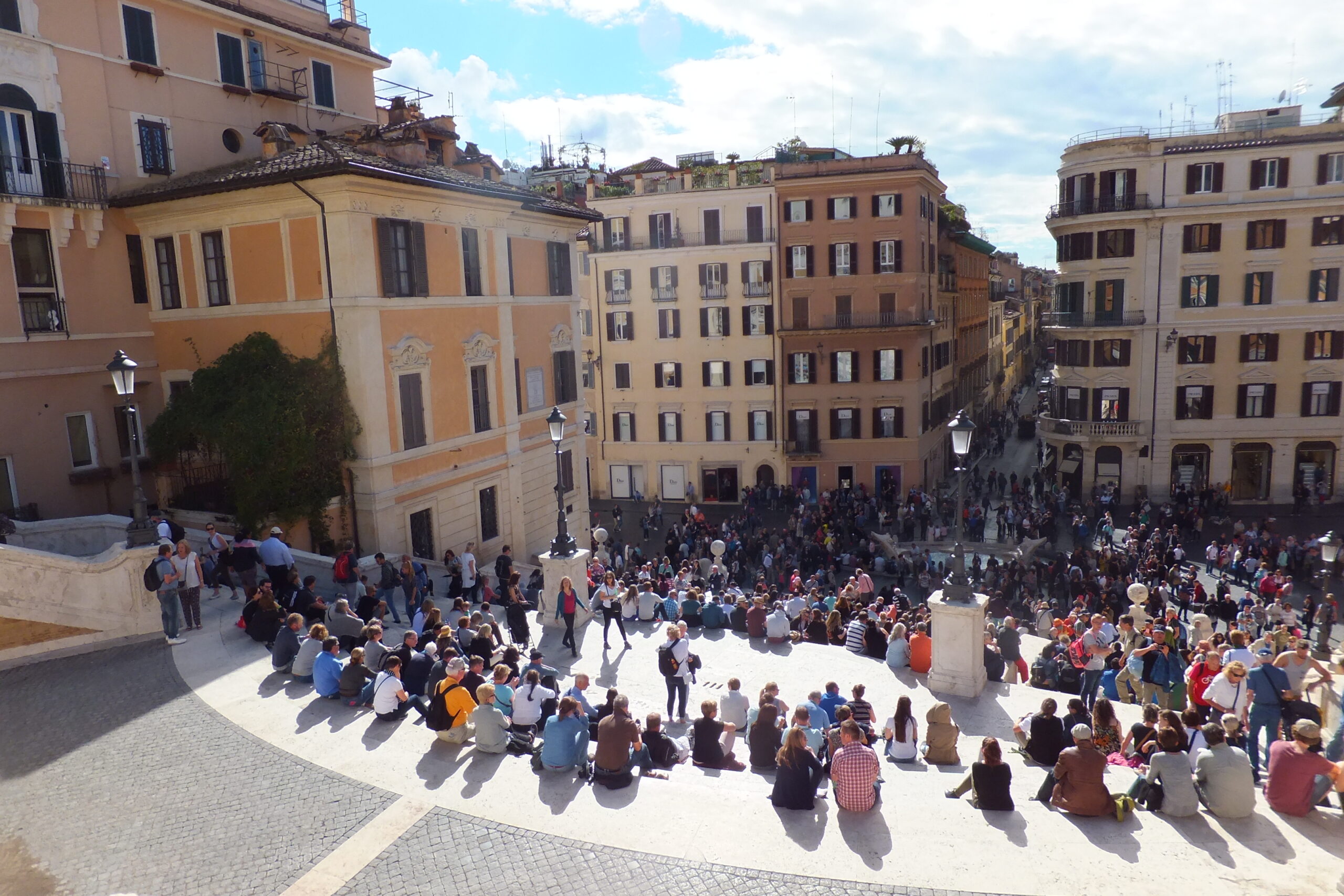
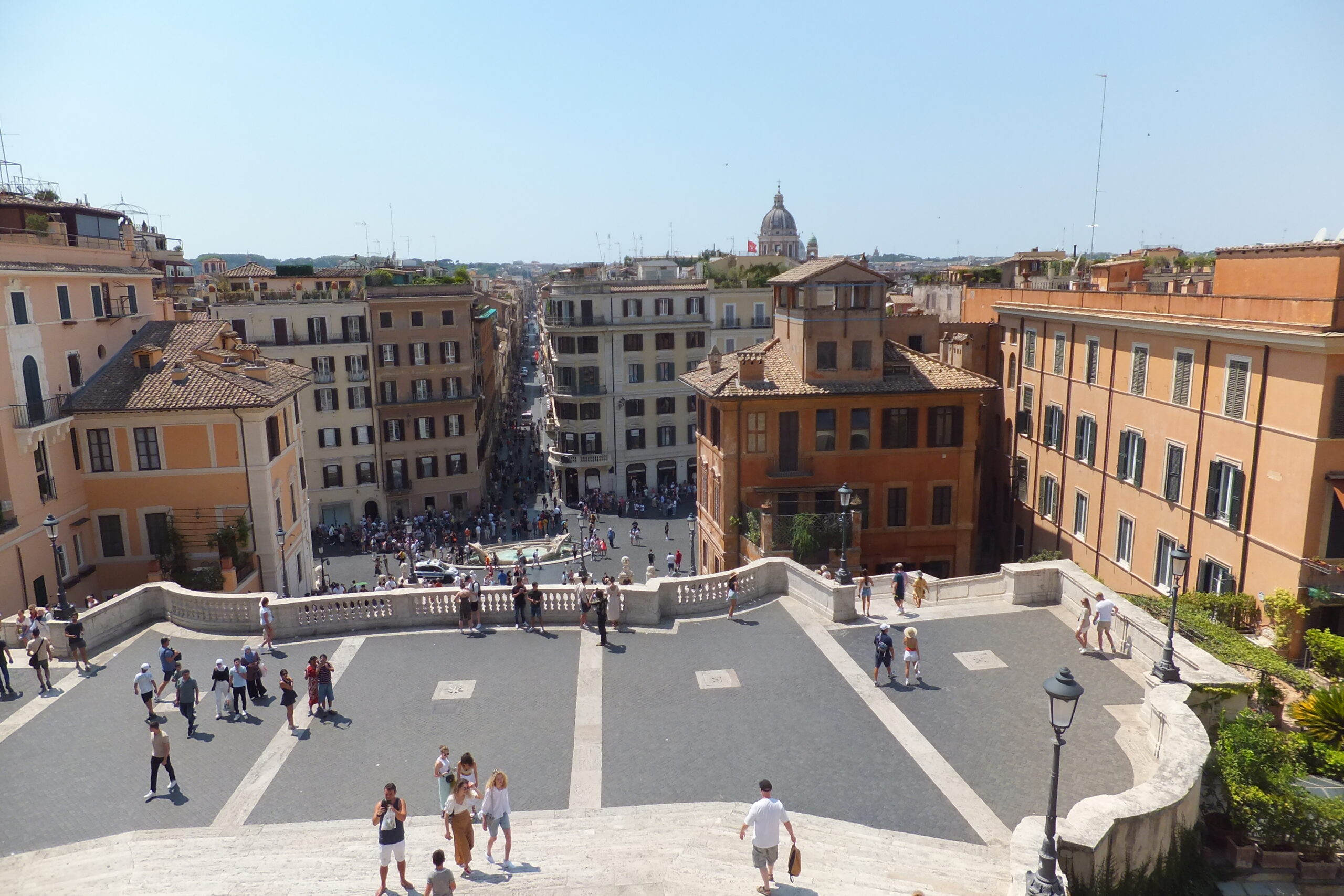
Today, visitors flock to Piazza di Spagna and the Spanish Steps to meet friends and take photos.
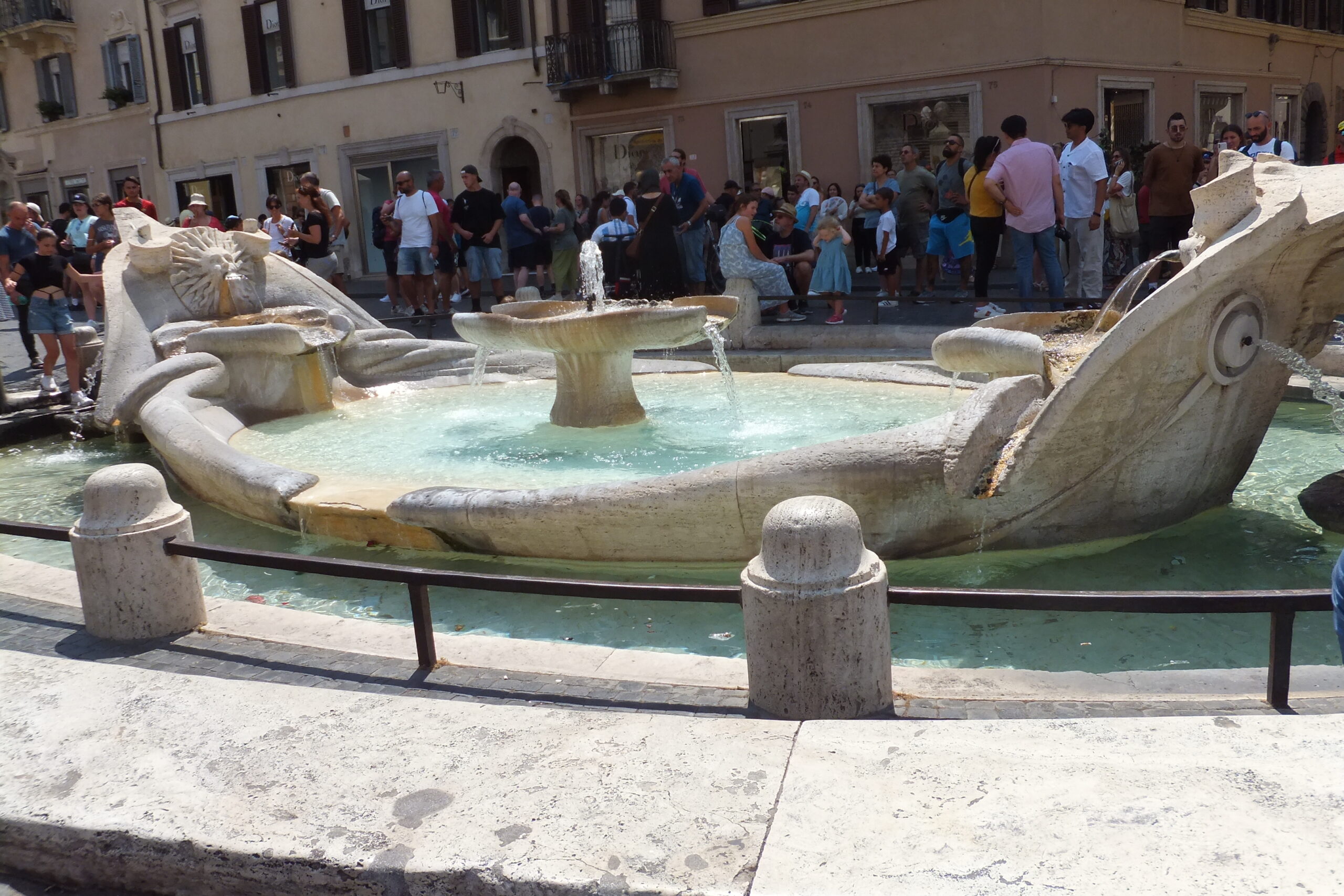
On hot summer days the boat fountain (Fontana della Barcaccia), designed by Pietro Bernini, is a major attraction.
This Piazza is an important thoroughfare. Head northwest along Via del Babuino and you will soon reach Piazza del Popolo, one of the historic entrances to Rome. Turn instead into Via Condotti or one of the parallel streets and you will be surrounded by shops and restaurants. Keep walking if you prefer and you will arrive at the busy Via del Corso.
Via due Macelli to the southeast leads to Via del Tritone, where you can walk uphill to Barberini or downhill to Via del Corso.
Instead, you may choose to climb the Spanish Steps. At the top is the church of Trinità dei Monti and its Piazza. You can enjoy the views and watch artists as they paint or draw. Villa Medici (the French art academy) is next door and the Borghese Gardens above. Via Sistina leads southeast to Barberini.
World War II
In the second world war, Piazza di Spagna remained an important thoroughfare and meeting place. It was also a place of surveillance where people were watched and followed.
Numbers 26 and 62 Piazza di Spagna have their own stories.
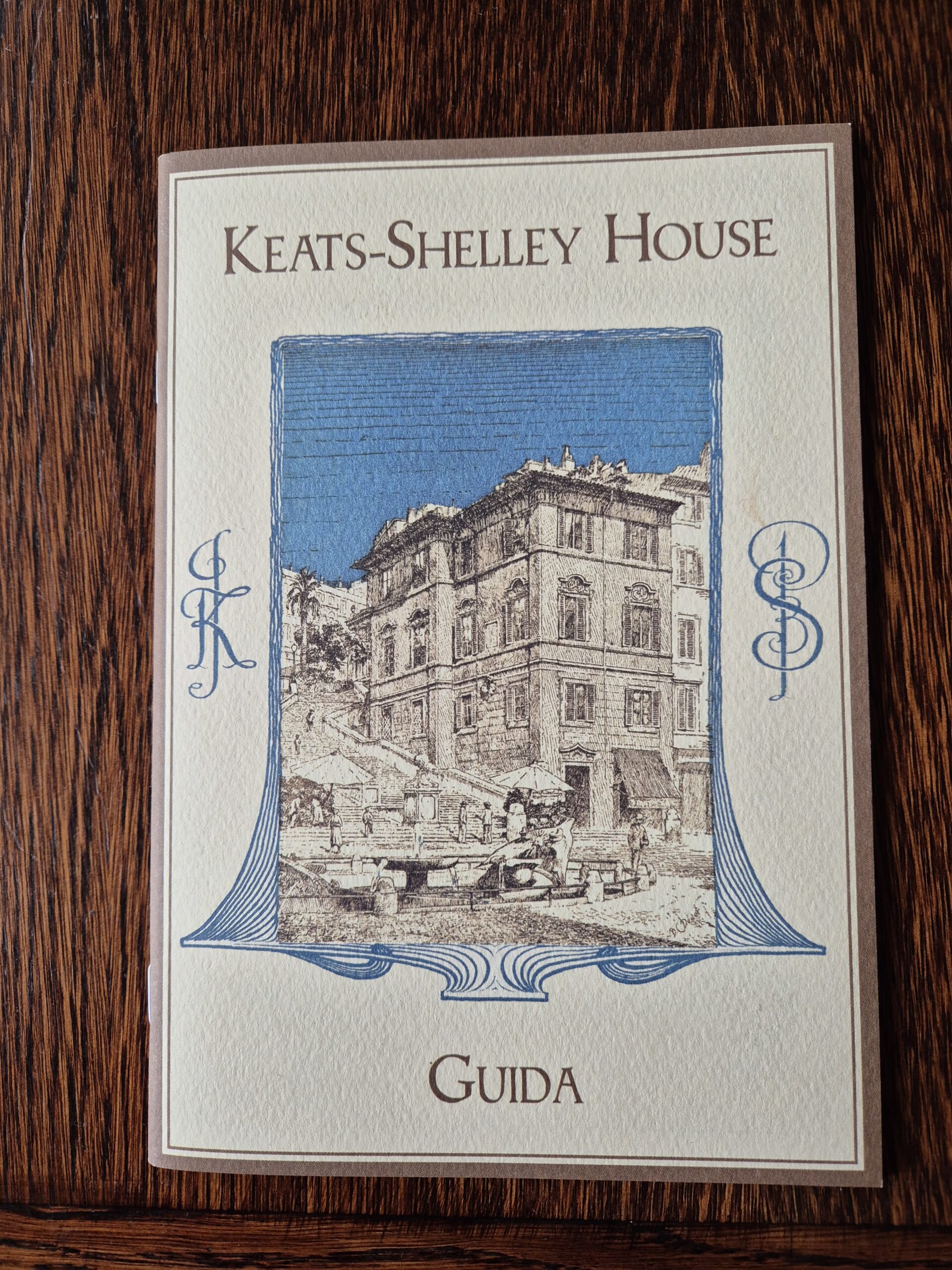
No 26: The Keats Shelley Memorial House and Museum in World War II
Italy entered the war in 1940, as an ally of the Germans, with the British amongst the enemy forces. By the end of 1941, Vera Cacciatore, the curator of the Keats Shelley museum, feared that this museum, dedicated to two English poets, might become a target. She removed the plaques from outside, rendering the building anonymous, and the museum was placed under neutral Swedish and Swiss administration.
Most of the volumes relating to Keats’ and Shelley’s work remained in the museum but Vera Cacciatore selected some of the museum’s most important and irreplaceable possessions: the last drawing of Keats by Joseph Severn; a drawing by Keats of a Grecian urn; two first editions of Keats’ poems; locks of hair; and original letters. She placed the items in two small boxes and sent them to the Abbey at Monte Cassino for safekeeping. At that time, many national treasures were being stored there.

The Abbey of Monte Cassino.
It was ruined after prolonged fighting in 1944 and rebuilt after the war.
Italy signs an armistice
In the summer of 1943, Italy’s position in the war changed dramatically. Early in July, allied troops (predominantly from the USA and Britain) landed in Sicily and soon crossed to the Italian mainland. At the end of July, Italy’s king dismissed Mussolini and imprisoned him. In August, Italy’s new prime minister, Badoglio, declared Rome an open city, hoping to avoid damage to its monuments and treasures. In September, Italy signed an armistice with the allies, who were by now advancing northwards through Italy.
Italy was no longer an ally of Germany; German troops immediately occupied Rome and continued to oppose the allied advance.
Monte Cassino lay directly in the allies’ path to Rome and it was no longer a safe place to store historic and artistic treasures. In October, the Germans decided to evacuate the Monte Cassino archives and take them north.
Return to Rome
The archivist at Monte Cassino appreciated that the artefacts from the Keats Shelley museum were vulnerable. He secretly put the boxes with his personal possessions, which were taken to the Benedictine house of S. Anselmo on the Aventine in Rome. He sent word to Vera Cacciatore who reclaimed them, although Rome was still under German occupation.
After Rome was liberated, the museum unsealed the boxes in the presence of the USA and British ambassadors.
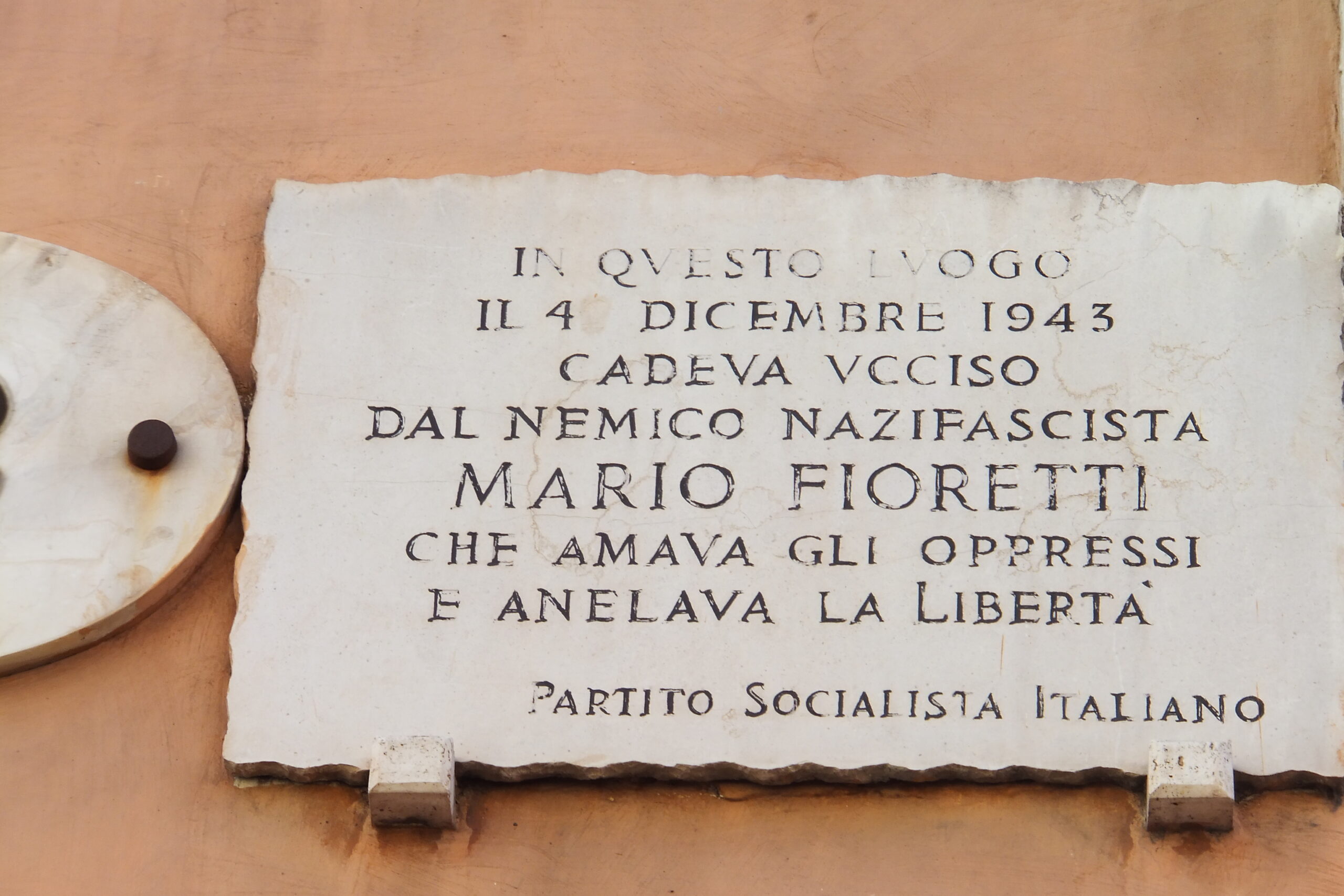
The plaque commemorating Mario Fioretti at no 62 Piazza di Spagna
An important thoroughfare with many routes of access, Piazza di Spagna bore witness to armed conflicts and arrests during the German occupation.
Mario Fioretti was 29 years old, a lawyer and magistrate. He was also a socialist and antifascist and belonged to a group that prepared and distributed a clandestine newssheet: ‘Avanti!’.
After the Germans occupied Rome, he spoke at ad hoc rallies, encouraging citizens to carry out acts of resistance.
On 4 December 1943, Mario Fioretti was returning from a rally, held in the Flaminio district. He travelled back through Piazza del Popolo and arrived at Piazza di Spagna, not realising that he had been followed by a soldier of the Guardia Nazionale repubblicana (faithful to Mussolini’s republic and the occupying Germans). It was daylight and the Piazza di Spagna was crowded but the soldier shot him outside no 62. He fell to the ground and, according to an eyewitness, a second soldier shot him one more time, to make sure he was dead.
A plaque in memory of Mario Fioretti is at no 62 Piazza di Spagna, donated by the Italian socialist party. A street was later named after him in the Monteverde district.